TABLE OF CONTENTS

BOWMAN SCHOOL HANDBOOK 2003 - 2004
(4/8/2004 Revision)


Principal’s Message

- Guiding Principles

School Council Members

PTA Officers

History: The Bowman Family and Lexington


Children’s Safe Arrival

School Hours

Attendance

Emergency School Closing

Traffic Flow

Buses

Changing Dismissal Arrangements

Bicycles, Skate Boards, Scooters, and Roller Skates

Recess

Birthday Celebrations and Party Invitations

Bowman School Extended Day

Building Security

Emergency Information for Students

Safety for Children

Delivery of Items to Students

Items Not to Come to School

Dress

Substitute Teachers and Other Assisting Adults

Lost and Found

Pets


- Routine Calls

- Contacting a Teacher/Staff Member

- Protocol for Expressing Concerns

- Moving from or within the School District


- Broadside

- Back To School Night

- Curriculum Night

- Teacher Conferences

- School Council Meetings

- Room Parents

- Telephone Calls by Students


Responsibilities of Teachers, Students and Parents

Homework at the Elementary Level

Request for School Work During and After Family Vacations

Process of Obtaining Further Assessment and Help for a Child


- Phase 1: Gathering Information

- Phase 2: Creating a First Draft of Balanced Classes

- Phase 3: Through Team Designees, Review of the Draft Lists

- Phase 4: Revising the Lists

- Phase 5: Assigning Teachers’ Names

- Phase 6: Communicating with Parents and Students

Request for Changes

Student Transfer Process Guidelines

Special Needs Placement

Placements for Emotional Adjustments and/or Learning Needs


- Purpose

Spectacular Learning for Life

- Student Goals

- School Culture

The Role, Rights and Responsibilities of Bowman Students

The Big Responsibilities of the Student

Students’ Rights and Responsibilities

Staff Roles and Responsibilities

Behavior Expectations and Consequences

General Disciplinary Process and Consequences for Misbehavior

Summary of Student Misbehavior Consequences

Misbehavior Examples

Misbehavior Consequences

Disciplinary Process for Serious Misbehavior

Serious Misbehavior Examples

Serious Misbehavior Consequences

- Disciplinary Process for Severe and Emergency Misbehavior

- Severe Misbehavior Examples

- Severe Misbehavior Consequences

- Emergency Misbehavior Examples

- Possession of a Dangerous Weapon, Controlled Substance, etc.

- Additional Provisions Regarding Suspension at Bowman

- Discipline and Students with Special Needs

- Special Education Regulations

- Rule Review and Revision


Bowman School Expectations

Bowman School Improvements Plan for 03-04


Please note:  This handbook is to be used in tandem with the Elementary Handbook for Parents, Students and Teachers, 2000-2001 Edition, posted on the system webpage at http://lps.lexingtonma.org/


It’s a pleasure to welcome you to Bowman School and to welcome you back if you have been with us before.   We are committed at Bowman to providing a nurturing environment to promote academic ex
cellence for all students.

This handbook is designed to provide parents and students with information about Bowman and how we do things here.  Please let us know if we have left out information which would be helpful to those joining our community.

The followin
g guiding principles for Bowman School’s operation are the important “mountains in our landscape” and serve as reference points for our more specific goals and procedures.


--SAFETY, RESPECT, CARING AND RESPONSIBLITY

--ACADEMIC EXCELLENCE FOR ALL STUDENTS

--STANDARDS BASED LEARNING STRATEGIES

--SUPPORT FOR INDIVIDUAL INITIATIVE, CREATIVITY AND INTERESTS

--BRINGING INFORMATION TO LIFE AND NEW KNOWLEDGE TO LIGHT

--CHARACTER, CONTRIBUTION AND CITIZENSHIP

--SKILLS AND JOY IN THE CHALLENGES OF LIFE LONG LEARNING

--SUPPORT FOR TEACHING

--COMMUNICATION AND SHARED IDEAS

--CELEBRATION AND RENEWAL OF OUR BROAD SPECTRUM COMMUNITY

We expect a lot of our students and believe the best way we can help them to succeed is to help them to work and play at being effective learners so they can learn well anywhere, all of their lives.

Key to learning is respect, that is seeing through the eyes of others and caring to do the best for all, even when we don’t quite want to.  We support and guide students to become skilled in:

*respecting

- themselves,

-
others and our differences,

-
the challenging and exciting process of learning,

-
hard work,

-
excellence,

-
and the environment in which we learn and which we will pass on to our children

*trying hard to go further

*trying to be open to new ideas and ways of doing things

*asking good questions

*being open about mistakes and not knowing

*knowing and using interests and strengths, and building new ones

*returning to problems not yet solved

*taking good risks and doing so carefully

*rising to the challenge of tests and being skillful and confident

*changing their minds and doing so carefully

*seeking help when stuck after having tried hard and creatively

*working hard and well with others, including trying to see how others see

*supporting themselves and others, even after making mistakes

*resting and enjoying

*thinking, reflecting and dreaming

*celebrating progress, their own and that of others.

We need to help each other to keep improving in all of these areas.  The more we do, the more effective, exciting and meaningful our lives will be.

Malcolm L. Astley, Ed.D, Principal


By state law each public school has a School Council which advises the principal regarding the school’s functioning and improvement.  The Council is comprised of the principal, an equal number of parents (elected through the PTA), professional personnel (elected through the Lexington Educators’ Association, and other community members appointed by the Principal.  Council members this year are as follows:

Community Member:
Roz Zimmerman
160 Marrett Road
781-861-9919
rpzimm@rcn.com
5th grade liaison

Parent: Robin Lipson Fishman
35 Locust Ave.
781-674-2477
robinlipson@rcn.com
4th grade liaison

Parent: Jayne Doherty Molgaard
43 Moreland Ave.
781-862-5031
dohjay@rcn.com
2nd grade liaison

Parent: Wendy Manhard, Time Keeper
475 Concord Avenue
781-862-0476
wendyjbm@hotmail.com
3rd grade liaison

Parent: Lori Moresco
1025 Massachusetts Avenue
781-861-9414
1st grade liaison

Staff: Kirsten Sweet, 1st Grade
781-861-2500
ksweet@sch.ci.lexington.ma.us

Staff: Anne Hamlin, 4th Grade
781-861-2500
bhamlin@sch.ci.lexington.ma.us

Staff: Elsa Mendez-Khawja, Spanish
781-861-2500
emendez@sch.ci.lexington.ma.us
One year running from July,
2003 through June, 2004
Appointed yearly by principal


Two years running from July,
2003 through June, 2005


Two years running from July,
2002 through June, 2004


Two years running from July,
2002 through June, 2004


Two years running from July,
2003 through June, 2005


Two years running from July,
2003 through June, 2005


Two years running from July
2002 through June, 2004


Two years running from July,
2003 through June, 2005


Principal:  Malcolm Astley
(W) 781-861-2500
(H) 508-358-2946
mastley@sch.ci.lexington.ma.us


Steven Iverson, President
781-863-2210
siverson@usa.net

Sarah Forrester, Co-vice-president
781-861-6111
sforre1953@aol.com

Wendy Manhard, Co-vice-president
781-862-0476
wendyjbm@hotmail.com

Ann Redmon, Treasurer
781-652-8644
ann@gant.org

Kelly Suber, Secretary
781-862-4725
kellysuber@hotmail.com


Nathaniel Bowman, for whose descendants this school is named, was the founder of one of Lexington's first and most important families.  As a young man he sailed from England with "The Winthrop Fleet" in the great emigration of 1630, becoming one of the earliest settlers of Watertown.  In 1649 he purchased lands from Edward Goffe, an original proprietor of "Cambridge Farms" whose grant comprised the south-easterly corner of present Lexington.  Here, near Bowman Street, Nathaniel built his homestead.  Later generations settled or owned large tracts in the vicinity of Watertown Street and as far beyond as Marrett Road.

Lieutenant Francis Bowman and Captain Joseph Bowman, grandsons of Nathaniel, were two of Lexington's most prominent and influential citizens.  Over a period of many years their counsel was continually sought.  They were foremost in organizing and guiding the Parish and the Town throughout all the formative years.  Francis was a member of the first Board of Selectmen and both brothers served as Selectman for long periods, as well as on town committees and as Representative to the General Court.  From these two men came the many descendants who continued the tradition of service to Lexington, notably their sons:  Isaac Bowman, who was elected to every position of importance in the town's government, as well as Representative.  in his later life was appointed to the committees which drew up “Resolves and Instructions” in the years prior to the beginning of war in 1775; Rev. Jonathan Bowman, second Lexington boy to graduate from Harvard College and teacher of the school in this town, son-in-law of Rev. John Hancock, became a prominent clergyman in his own right; Capt. Thaddeus Bowman, who lived near Pleasant Street, was noted as an able town officer, Moderator, and a member of the Committee of Correspondence.  In 1774 he was Lexington's representative to the Middlesex Convention, which body in that critical year was instrumental in the formation of the Provincial Congress.

Thaddeus Bowman, almost certainly, was the scout who brought the first definite news to the Common on the morning of April 19, 1775, that British troops were already approaching in Lexington.  With the outbreak of war the obligations were met by another generation.  Ebenezer Bowman faced those British troops on April 19th with Capt. Parker's company and his brother, Solomon Bowman, saw action later that day.  Francis Bowman, member of Capt. Parker's company, in 1775, also marched in 1776.  Lieut. Samuel Bowman was on duty in 1775 and continued to serve throughout the Revolution.

The last member of this family in Lexington was Mrs. Sarah Bowman VanNess, who died in 1933.  Near her home on Pleasant Street was the tract of Bowman land which was given to the Town in 1901, under the will of her husband, as a memorial park forever.  Bowman Park, accepted in town meeting, now contributes to the preservation of an attractive entrance to Lexington.  It is the last evidence of the devotion of members of the Bowman family, who for so long were distinguished by conspicuous leadership and service on behalf of their town.

By   Edwin B. Worthen, Jr.


GENERAL INFORMATION

CHILDREN'S SAFE ARRIVAL


To help insure children’s safe arrival, please let the office know if your child will be absent by calling 781-861-2503.  Your call will also help save us a call to your home to be sure your child has been accounted for.


Children are permitted on the playground at 8:15 a.m. when staff are available to supervise them.  For their safety, children cannot come earlier.

Students are admitted to the school at 8:30 a.m. or to the cafeteria at 8:15 a.m. in the event of bad weather.  Students must be in classrooms by 8:45 a.m. to be considered on time.  The school day runs until 3:15 p.m., except Thursdays when students all leave at 12:15 p.m.

The kindergarten day runs until 12:15 p.m. each day.


A child not in the classroom by 8:45 a.m. is considered tardy.


Please remember to call the Safe Arrival Line (781-861-2503, to notify the school of your child’s absence.  Whenever your child is absent from school, a note with parent or guardian signature, explaining the reason for the absence, is required upon the first day of return.


It is a rare occurrence that school is cancelled because of an emergency during the day (e.g., mid-day snow storm, no heat), but when this happens the principal initiates a calling system to alert parents that the children are coming home earlier than usual.  Every effort is made to reach a parent or guardian; arrangements are made for the child to go to designated emergency contacts until the parent or guardian returns if s/he is not home.

We ask every parent to discuss with his/her child what to do in case of an emergency school closing.  Each family, too, is asked to develop an emergency plan for challenging circumstances.

To prevent jamming of phone lines, we ask you not to suggest that your child call you.


Our constrained parking easily makes traffic patterns frustrating at Bowman.  Your cooperation is appreciated in observing the following procedures to minimize the problems.

1.  No parking is allowed in the yellow curb area in the front of the school at any time.  Emergency vehicles, buses, and delivery trucks need access to the yellow curb area. Police periodically patrol the area and may give tickets.

2.  In the mornings please do not drop children off at the flag pole, but pull as far forward as possible to the front of the yellow line so that as many cars as possible can drop children off at once.  Otherwise the line moves much too slowly.

3.  At the end of the day pick-up of children occurs at the yellow curb in front of the school and live parking only is allowed.  Drivers are asked to stay in their cars, please, and to move forward immediately for the sake of those behind when space is available in front.   Please move as far forward as possible at the yellow curb before picking up your child.  Pick-up is to happen only at the yellow curb unless you have made arrangements with the school in writing for your child to meet you on another street.   For safety reasons children are not allowed to move between cars for pick-ups.  No double parking is allowed in front of the school except to form the line coming to the yellow curb. (Otherwise the driveway becomes hopelessly clogged.)

-
b. Please do not block the intersection at Philip Road as you turn to form the pick-up line in front of the school.  Wait until the line has moved forward before going into the intersection.

-
c. Cars are not allowed to enter the back lot near the gym at the end of the day (3-3:35) since buses pick up children there and turn around.  Please do not park in the bus turn area near the gym and back of the school.  Please do not block the crosswalks or intersection where the buses need room to enter and leave.

4.  Care is requested in leaving the space near the front entrance accessible as a parking space for the physically challenged.

If these guidelines are observed, the front of the school pick-ups are usually complete within 10 minutes. Thanks for your cooperation in tight circumstances.

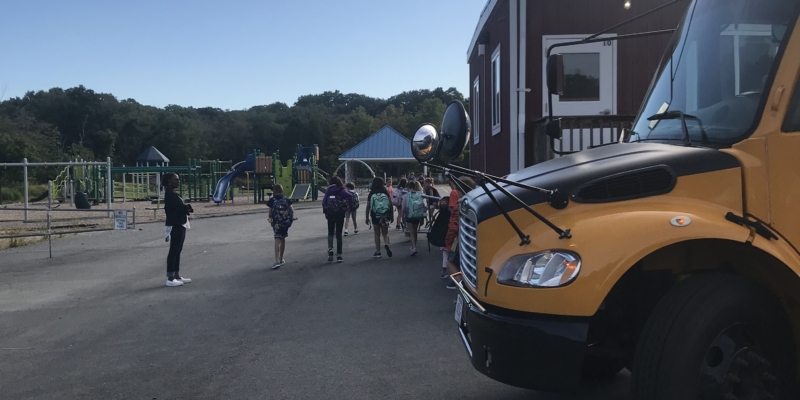
Bus transportation is available free of charge to students living 2 miles or more from their district elementary school. If a student lives up to 2 miles from the school, bus service is available on a fee basis. Each spring, bus registration and fee information is distributed through the school.


Approximately one week before school begins, bus routes and approximate times are published in The Lexington Minuteman. Students should be at their stops at least five minutes before the scheduled time.


To prevent overcrowding, students must take their assigned buses home. Guests and switching of buses are not allowed. The only two exceptions are for students attending Hayden after school programs and for Boston students visiting Family Friends. If a student does not regularly ride a bus, a fee for transportation to Hayden must be paid.  This information and fees are listed on the bus registration form sent home in the spring, or call the office (781-861-2500).


If a child’s transportation plans will be different from usual ones, parents are asked to notify the classroom teacher in writing. If students are going home with another child, both children’s parents must write a note to confirm the arrangements.  To allow time for arrangements to change dismissal plans, calls should be made to the Bowman School Office before 2:00 PM (781-861-2500).


Children in grades 3-5 may ride bicycles to school when their parents consider them able to ride their bicycles safely and to negotiate the roads between home and school.  Helmets are requested.  Bicycles are to be parked only in the bicycle racks provided in front of the school.  For the safety of all, bicycles are to be walked in front of the school building. The school accepts no responsibility for bicycles brought to school.  Bicycles ridden to school are to be brought directly to the bicycle racks and left there for the entire school day.  There is no bicycle riding on the school property when school is in session.  We suggest that if your child brings a bicycle to school, the bicycle be equipped with a sturdy lock and chain.  Also, please register bicycles at the police station.  Registration serves at least two purposes:  (1) it deters theft and (2) it places on file the serial number of a bicycle and can help you to prove ownership if a bicycle is stolen and later recovered.

For safety and order, skate boards, scooters, and roller skates are not permitted on school grounds.


Recess usually occurs twice a day and once a day on early release days. Children go outdoors with their classes or grade level groups supervised by playground educational support personnel. Students should bring appropriate outdoor clothing to school. Snow pants and boots are required when snow is on the ground. During bad weather, children may have supervised recess indoors.  Whether recess is held outdoors or indoors, it is at the discretion of the principal.  Children are expected to wear coats at temperatures below 60º. Recess is held outdoors at temperatures above 20º, including the wind chill factor.

Safety and behavior rules are included in the Bowman School Expectations flyer in the back of this handbook.

The school physician and nurses have determined that if children are well enough to attend school, they are well enough to go out during the recess period.  Exceptions to this ruling would include children with doctor requests.  Parents should send any doctors’ notes to the classroom teacher requesting that children be exempted on a particular day
.


Children are welcome to celebrate their birthdays by offering their classmates a token of some kind such as stickers or a special pencil.  Arrangements should be made with the classroom teacher beforehand if a child wishes to bring a birthday token to school.

Please check with your child’s teacher regarding any possible food allergies children in a class.  Alternatives to food, such as a special pencil, are encouraged.  “Any foods sent into a classroom for sharing/distribution to the children in the classroom where there is a child who has a life threatening allergy … needs to be unopened and prepackaged with an intact ingredient label,” according to the system policy on Life Threatening Allergies.

Parents of children with dietary or religious restrictions should inform their child’s teacher about how the child is to handle birthday snacks brought in by other children.

Birthday celebrations should be simple and planned with the teacher; please, no drinks, gifts, balloons, candles, or video taping.

If a child’s birthday does not fall on a school day, the child and teacher may choose another day to celebrate.

To avoid hurt feelings, children should not bring birthday invitations, cards or presents to school. Addresses are printed in the Bowman School Directory so that invitations can be mailed home.  Birthday party invitations should not be handed out in class unless all children in the class are invited.


The Bowman School Extended Day Program, which is run by an independent administration, provides a safe, supportive environment to meet the varying needs of the participating children.  Each day there will be time for indoor and outdoor play, a nutritious snack, and a variety of arts and crafts in a relaxed, well-supervised situation.  Activities will be planned to allow the children to move at their own pace and with their own style.

The Program is held from 12:00 noon until 6:00 p.m. when school is in session.  The Kindergarten children may attend from 12:00 noon until 3:00 p.m. or stay until 6:00 p.m.

A one-month deposit, not to exceed $100 per family, is required.  Enrollment is for a full semester - September through December and/or January through June.  The minimum enrollment is three blocks per week.   Two afternoons must be in addition to the Thursday 12:00-3:00 block, if your child requires care during that time.  Checks are made payable to Bowman School Extended Day Program.

Fees have been established on a monthly basis.  They take into account variations in the school schedule (i.e., school vacations).  Payment is due on or before the first of each month.  Please make your payment promptly.  There will be a late charge if payment is not made by the 15th of the month.

At the time of registration, each parent will receive a handbook containing important information concerning the Program and forms that will have to be returned to Extended Day along with a deposit to assure a space for your child.  If you have any questions, please contact Kathleen Brady Walker, Director, at Extended Day (781-863-1912) or at home (781-449-5023).


We welcome visitors, but must also look after the safety of all in the building.  The office is open from 8:00 a.m. until 4:00 p.m.  All visitors, parents included, must use the main entrance, report to the main office, check in with office personnel, register in the Visitor Log, pick up an identification badge, and return the badge and sign out at the end of your stay. Entry access during the day will be limited to support security.

Parents dropping off children after the day starts (8:45 a.m.), picking up children during the day, or dropping off items for children are asked to come to the office first.  For safety and to prevent disruption of learning, we will have children sent to the office for pick-ups or to classrooms as needed.  We will see that items are delivered to classrooms. Adults present in the building without guest badges must expect to be questioned, and we appreciate your understanding.


The safety of children is of paramount importance. Good communication between school and home is essential to promote safety. It is important that the school be able to reach a parent or guardian by telephone in case of an emergency or a potential problem. In the fall you will receive a Bowman School Emergency Information Form from the office. Please complete it carefully and return it the first day to ensure the school is able to reach you. Also, be sure to notify the office of a business or home telephone number change.

If your child is going to be absent, please call the Safe Arrival Line (781-861-2503) and leave a message.


1. Teach children that if they are being followed, they should run to other people in a lighted area; they should not hide.

2. Listen when a child says he or she doesn’t want to be with someone. There may be a good reason.

3. Don’t allow children to carry items or wear clothing that displays their names. A child is likely to respond to someone who uses his or her name.

4. Select a secret code word to use when someone else is picking up your child. Teach your child never to go with someone who doesn’t know the code word.

5. Encourage children to use the buddy system whenever possible, and make them aware that there is safety in numbers.

6. Instruct children never to respond to or go with strangers who approach them in a car or offer to show them something special, like a puppy.

7. Teach children never to accept gifts from strangers and to avoid being alone with overly friendly adults who try to touch them in any way.

8. Teach children important emergency telephone numbers (911), and post a list near the telephone of numbers for family and neighbors to call for help.


All medicine must be given to the nurse.

If a child forgets to bring an essential item to school, parents should drop the item off at the Bowman School Office. It will be delivered to the child as soon as possible. This practice prevents classroom interruptions and supports security.


Certain kinds of equipment have to be prohibited from school because of potential danger, risk of loss, theft or damage, or risk of distraction of students from the school's main purposes. Skateboards, scooters, roller skates, electronic equipment and water guns or imitation weapons are not allowed in school. If they are brought to school, they will be kept in the office until the end of the school day. The incident will be treated in terms of misbehavior.

For their own protection, students are also asked to bring neither personal possessions of unusual value (unless prior arrangements are made with teachers) nor sizable amounts of money.

Toys are not permitted unless prior permission is obtained from the teacher involved.  If toys are brought without permission, they will be kept by the teacher or office personnel until the end of the day.

Food is not permitted except for designated school snack times.  Other food will be kept by school personnel for a parent to pick up.

Students on the Boston bus are allowed to bring sound equipment with earphones.  The equipment must be stored in backpacks upon arrival on school grounds.


There is no formal dress code at Bowman. Students are asked to wear clothing appropriate to the importance of school and learning and which will not interfere with students taking part readily in the normal learning activities of the school day. Students may not wear clothing which is significantly distracting from the school's purposes, spirit and routines, nor clothing which has writing or symbols which are distracting or insulting to others (example: suggestive clothing, alcohol or tobacco ads).  Hats may not be worn within the school building.

In physical education classes all students are required to wear supportive sneakers, and clothing which allows freedom of movement.


Substitute teachers and assisting adults often have a difficult job. They are vital to the operation of the school and need extra support from students, staff, and parents. Students are asked to be prepared to accept and help out with activities and procedures that may differ from the standard routines.

Uncooperative behavior with a substitute is a serious matter which will be handled by the classroom or homeroom teacher upon return from an absence according to the Serious Misbehavior Category in the Discipline Code. Tutors, aides, office staff, custodians, volunteers, and cafeteria personnel similarly deserve our respect and our support.   Uncooperative behavior with an assisting adult will be dealt with according to the Serious Misbehavior Category in the Discipline Code.


"Lost and Found" pegs are maintained on the east wall in the cafeteria.  Parents are welcome to examine the school's lost and found for missing items.  Small items, such as jewelry, keys, glasses, and coin purses are kept in the office.  Unfortunately, many items of value remain unclaimed. Such items are given to a charitable organization on a monthly basis.


Dogs and other pets are not allowed in school without special permission.  If dogs are on the premises, we will try to identify and locate the owner in order that the dog is restrained.  If we are unsuccessful, we will have to call the dog officer to impound the dog.  Please abide by the leash law.


COMMUNICATION

Open lines of communication between school and parents are of vital importance to all of us.


PARENTS TO SCHOOL


(781-861-2500): Parents can contact Bowman 24 hours a day to leave a message for a teacher/ staff member or to notify the school regarding student absences (781-861-2503). Office personnel or a recording device are available to receive calls from 8:00 a.m. to 4:00 p.m. Messages will be returned as soon as possible.


When you have questions or need information pertaining to your child, we encourage you to contact the staff member who is closest to the situation and who can provide you with information or work with you on a solution.  If you are not sure whom to contact, you can always check with the office.

If a staff member is available to talk with you when you telephone, he or she will do so, but our priorities must be to avoid interrupting instruction except for emergencies. Messages will be taken if a staff member is not available.  You can expect a prompt reply to either your phone call or to a note sent to school.  The school telephone number is 781-861-2500.


If a parent has a concern or question or would like to offer a suggestion concerning school practices, we would like to hear about it.  At the same time, we need to organize such comments effectively into the on-going workings of the school.  If the situation at hand requires rapid attention, we will respond on an emergency basis.  If the situation or concern relates to longer term planning, we will see that an appropriate committee or planning group is made aware of the concern for future work.  To support responsibility and accountability at each level, we ask that you follow these steps in bringing matters to our attention:

Step 1: Please contact the teacher directly if you have a concern related to your child's classroom.  Registering a concern rarely feels easy, but we are committed to the process of communication being safe and going well for all parties.  Preparatory talk with other teaching staff, the guidance counselor or an administrator, may help you plan for the most constructive talk together.

Step 2: If your concern is of a school-wide nature or if you and the teacher have not resolved the situation, then please call the principal.  We may suggest third party mediation which can often help.

Step 3: If your concern is of a system-wide nature or if you are not satisfied with the results of the conference in Step 2, then you are asked to contact the Director of Education or the Superintendent of Schools at the central office, 781-861-2550.


We would appreciate your letting us know as early as possible of any move out of the Bowman school district in order that we may prepare any of the necessary transfer papers.

If you are moving within the Bowman school district, we will need to update school and directory files.


With the help of the PTA the school publishes an informative bulletin twice a month that outlines programs and events for parents and children. It is sent home with students on the same day every week, currently Wednesday, and Thursdays on weeks with Monday holidays.  A calendar of upcoming events is included on each Broadside. The Broadside will be posted through the school website, available through the Lexington system home page at http://bowman.lexingtonma.org/broadside/broadsideupdate.htm.  We are now relying on electronic distribution.  Please give the Bowman office your email address to receive notification of the updated Broadside on-line.  If you want a hardcopy, please let the office know.


During one of the first full weeks of school an informal bring-your-own picnic and Open House is held at Bowman.


Later in the fall, parents are invited to a Curriculum Night where classroom teachers meet with you to share curriculum information and talk about their particular classroom plans.


Conferences are scheduled twice a year. You will be notified of them by your child’s classroom teacher.


These are held at least once a month, with the dates published in the Broadside. All meetings are open to the public and agendas are published on the School Council bulletin board in the main hall.


At the principal’s discretion, the PTA solicits two or more parent volunteers to serve as room parents to assist the classroom teacher as needed.


Children may use the office phone as necessary at the discretion of office staff.   With permission and supervision, the pay telephone in the hall may be used by students in grades three and above.


Homework is an important extension of activities begun in school by students under the guidance of their teachers and continued at home.  Working together, home and school can effectively guide students as they develop their learning capacities.

Homework provides for practice of skills and application of principles based upon work begun in the classroom.  It may enrich school experiences and promote a permanent interest in learning.  A secondary goal of homework is to stimulate individual initiative, personal responsibility and self-direction.

Due to differences in age levels and modes of instruction between elementary and secondary schools, homework expectations will necessarily differ among grade levels.


RESPONSIBILITIES OF TEACHERS,
STUDENTS, AND PARENTS


-
assign homework that is meaningful and useful to individuals

- provide appropriate and timely response to all homework assignments

- provide a balance between long-range and short-term assignments

- over weekends, give assignments, which are no longer than daily assignments

- not assign homework during vacation periods and on legal and religious holidays

- monitor long-term assignments in order to avoid last minute “crash” efforts by students

- give clear, concise directions; allow time for student questions; consider availability of materials;
provide legible worksheet when used

- inform parents of their role in supervising homework

- ensure that students who are absent know how they make up homework

-
monitor the effectiveness of homework as reflected in student performance


- record the directions for homework

-
ask questions when necessary to clarify the assignment

-
follow a schedule and keep materials in order

-
hand in, on time, neat, accurate, and meaningful products

- plan time for completion of long-term assignments

- determine and complete homework assigned during absence


-
provide a suitable place for study

-
help students develop routine home study habits

-
ensure that missed work due to absences is made up

-
assist and correct but do not do the actual work

-
notify the teacher if students experience extreme difficulty

-
be aware of long-term assignments and assist students in learning to budget their time
accordingly

-
contact the teacher if he/she observes absence of homework

-
discuss ideas and progress and focus on small errors last

Because the time required of individuals to complete assignments varies, homework activities must, therefore, be planned to meet each student's individual learning profile.  Though it is impossible to predict the time necessary for all students to complete assignments because of different learning rates and age levels, the following is suggested:


Grade K and 1

Grade 2

Grades 3 and 4

Grade 5
none regularly assigned

fifteen minutes each night

thirty minutes each night

forty-five minutes each night


Parents should allow a child to stop homework after a reasonable time and let the teacher know if a child is struggling with homework so appropriate plans can be made.

In addition, parents are asked to continue to read to and with their children and to encourage and support their children's recreational reading.

No homework will be given on legal and religious holidays or during vacations but may be given on weekends.


The school system's policy is that teachers have no obligation to provide assignments, activities, materials, and other school work for students who are absent from school because of family vacations or trips.  Teachers also have no obligation to provide make-up work for students who return to school from a family vacation or trip.

There are a variety of activities parents can organize for children going on a family vacation or trip which have educational value, e.g., keeping a journal or diary; drawing pictures of sights and experiences; interviewing people visited; making a scrapbook of postcards, photos, brochures, and newspaper articles of the areas visited; tape recording special events or conversations; writing postcards or letters to friends, classmates, and relatives; bringing books to read; and doing crossword puzzles available in collections.


1. A staff member, or parent through a staff member, usually begins the process for additional assessment and possible help by submitting a request in writing to Dr. Michelle Welch, Evaluation Team Leader.  She is chairperson of the Child Study Team and also coordinates Special Education assessment at Bowman.  The Child Study Team meets weekly to do initial planning for students in apparent need.

2. Information on the situation may be gathered by the Child Study Team members, and the request is discussed at a scheduled Child Study Team meeting.

3. The originating staff member attends an assessment meeting with the team.  If a parent has made the request, s/he may attend the meeting, but these preliminary meetings are usually considered staff consultations from which the staff member may bring information or recommendations to the parent.

4. Recommendations are developed leading to one or more of the following actions:

a. Further assessment involving standard school observations and measures (such as a reading test or classroom observations)

b. Modifications in the classroom or school program without involving Special Education services

c. Provisions of additional regular education services, such as services of the guidance counselor, reading teacher, or help from a volunteer upper grade student

d. Referral of the child for outside help or further assessment.

e. Referral of the child for Special Education evaluation.

5. While progression through the steps as outlined is considered prudent, a parent may consider a situation serious enough to warrant an immediate referral for Special Education assessment.  In that case a request in writing to that effect should be written to the Special Education Team Leader, Michele Welch.


Field trips held on school days are extensions of the instructional program.  Their purpose is to provide educational opportunities which cannot be offered within the building for acquiring appropriate skills, understanding and attitudes.  Whenever possible, the trips will be funded from the regular school budget; but with the high cost of transportation, we do ask for assistance.  Scholarships are always available, and at no time will any child be excluded because of inability to finance the trip.  Please contact the office if costs for a trip are a concern for you.


After fifth grade, students from Bowman advance to the Jonas Clarke Middle School. In order to acquaint parents and students with middle school procedures, several activities are planned. In the spring of 5th grade, the middle school administrators and/or guidance counselors visit Bowman to meet with the students and talk about middle school life. An evening for parents is scheduled in late spring, and a visiting day for the 5th graders is generally scheduled for early June. Anytime during the summer, a prospective student may make an appointment to tour the school to ease any tension about entering middle school that still exists.

In September, each team has a barbecue to help bring the team together.  Back-to-School Night for parents to “follow” their child’s schedule and to meet each of their child’s teachers occurs in late September or early October.

All of these activities help students make the adjustment to middle school a smooth one.


Below are the time line and the steps in the Bowman placement process.   No placement process is perfect, in part because each of us as parents/guardians wants to find and claim the perfect situation in life for our individual children.  Part of the important learning we need to help children grasp is that a placement process needs to work for the whole school.  In addition, each important adult in their lives will bring strengths and weaknesses.  Each adult brings gifts for the child’s gain.  Part of the child’s job is to be alert to those gifts and to be open to that adult’s approach.  Part of the adult’s job is to make accommodations for that child and to build bridges of accessibility for that child.  Part of the job of the home teacher and the school teacher is to communicate frankly, persistently and supportively to insure common ground and mutual support for the child’s learning.

Progress was made over the last years here in setting up an equitable placement process which emphasizes and tries to balance the needs of individual students, balanced classes for all of our students, and the long term quality of the whole school. The process emphasizes wherever possible the importance of:

a. balance as possible in all classes in regard to:  boys and girls, abilities of students, student needs, student learning styles, returning and new students, ethnic background (where possible without isolating students), number of students from each sending class, and student and family needs for teacher time

b. the expectation that each teacher will make appropriate accommodations and build accessibility for each child

c. the need to honor the interests of all of the students

d. clustering of SpEd or bilingual students to deliver services efficiently; and balancing classes in related appropriate ways

e. providing each child with a supportive peer-work mate, not necessarily a best friend

f. preventing repetition of specific parent-classroom teacher situations as needed

g. preventing repetition of specific student peer situations as needed

h. providing exceptionally able children with a workmate of similar ability